Identify Any Banknote
by Photo
Lay the note flat, fill the frame, take one picture. NoteBrain comes back with the Friedberg number, the series, the year, the seal colour and the signature combination — and it reads the serial number off the note and tells you whether it is one collectors chase.
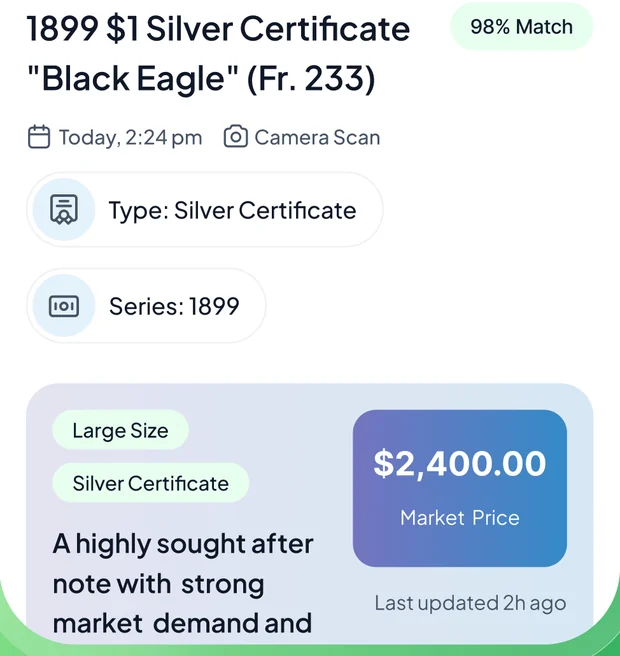
From the wallet to the archive
Photograph whatever is in the drawer — the app works out which bucket a note belongs to. You never have to pick a category first.
And the series types it asks about
- Federal Reserve Note
- Silver Certificate
- Gold Certificate
- Legal Tender
- National Bank Note
Three steps, one note at a time
No Friedberg catalogue open on the desk, no squinting at a signature you cannot place. Lay the note down and take the picture.
Photograph the note
Lay it flat and align it inside the frame. Shoot the face, turn it over for the back, or frame the serial number — whichever side has what you are trying to read.
Read the markers
Friedberg number, series, year, seal colour, signatures and serial number — whichever the photo can support, with a match confidence beside them and candidates to pick from.
File it in an album
Save it to an album you named yourself, with its condition estimate, market trend and last recorded sale sitting alongside it — and a running total for the collection.
More than an identifier — a collector's desk
Scanning is the front door. What keeps collectors in the app is everything that happens to the note afterwards.
Scan without a daily quota
No per-day allowance to ration across a shoebox of inherited notes. There is a fair-use ceiling to keep the service up, but ordinary collecting never reaches it.
The serial number is checked, not just read
It flags a star note from the suffix, then runs the digits against the five patterns collectors actually pay for — solid, ladder, radar, repeater and low serial — and tells you how many hit.
Six identification markers
Friedberg number, series, year, seal colour, signatures and serial number — the fields that pin a note to one catalogue line.
Albums & collection value
Sort notes into albums you name yourself and watch the collection total move, broken down by grade band.
Ask NoteBrain
Too worn to photograph, or no clean shot? Answer five questions — type, series, era, condition, and anything unusual about it — and the catalogue narrows itself down.
Photo enhancer
Clean up a dim or glare-heavy shot before it goes to the identifier — better input, better match.
Browse & search
Look a note up by name, or filter the catalogue by category, and open the same detail page a scan gives you.
Scan history
Everything you have identified stays in recent scans — re-open a note without photographing it twice.
A blank field beats an invented one
When the photo cannot support a marker, the app leaves that row out of the panel rather than filling it with a plausible guess — and a note the pricing has not reached shows no figure instead of a made-up one.
Every detail that pins a note down
A denomination and a year are the start, not the answer. The same face value across two series, two seal colours or two signature pairs can be worth wildly different money. NoteBrain reads the markers that settle it.
-
Friedberg number and series The catalogue reference that lets you look the note up anywhere.
-
Seal colour and signatures Blue, red or brown, and the Treasury pairing that dates the printing.
-
Serial number, read off the note Which is what makes the star and fancy-pattern check below possible.
-
Authenticity tips, not an authentication Things to check yourself. Only a grading service can certify a note.
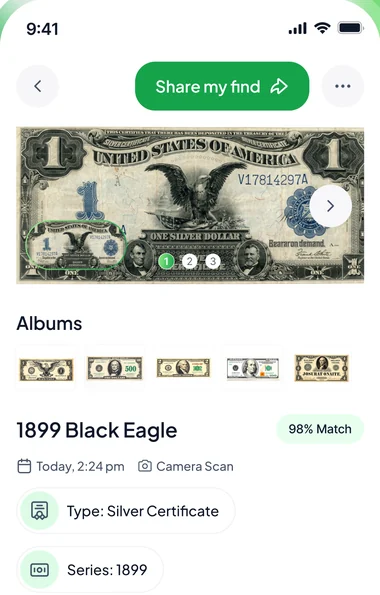
The eight digits nobody checks
Two identical notes, one worth face value and one worth a great deal more, and the only difference is the serial. Most people never look. NoteBrain reads it and runs it against every pattern the market cares about.
-
Star notes, from the suffix A star in place of the trailing letter marks a replacement note.
-
Five fancy patterns, ticked off one by one Solid (777777), ladder (12345678), radar, repeater and low serial under 100 — with a count of how many matched.
-
An indicative premium, clearly labelled The rarest matched pattern comes with a guide range over face value. It is a rule of thumb, not a quote.
-
Worked out on your phone The pattern check is arithmetic on the digits, so it is the same answer every time.
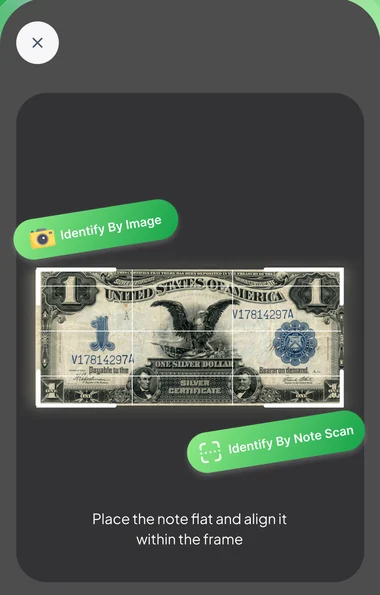
Straight from inside the app
Real screens: frame the note, then read what came back.
Taken from the NoteBrain App Store screenshots. Note names and figures shown are examples — what the app reports depends on the note and its condition.
What you get with NoteBrain
NoteBrain is a subscription app: the download is free, and full access comes with the subscription. Where your store offers an introductory free trial, the purchase screen shows it before you commit.
Start with the appPrice, any introductory offer and renewal terms are set by the App Store or Google Play and are shown on the purchase screen in your region before you buy. If a trial is offered it converts to a paid subscription unless you cancel beforehand, and you can cancel any time from your store subscription settings.
-
Banknote scans without a daily quota US large and small size, world and obsolete.
-
Six identification markers Friedberg number through seal colour and signatures.
-
Star note & fancy serial check Five patterns run against every serial it reads.
-
Collection tracker Albums, a running total, and a breakdown by grade band.
-
Ask NoteBrain Five questions when a photo will not do it.
Questions, answered
The things collectors ask us before they download.
Check the serial before you spend it
Free to download. Take the oldest note in the drawer, photograph it, and see what the serial says.